
NVIDIA has officially unveiled DLSS 4.5 at CES 2026, bringing major advancements in AI-driven graphics rendering. Building on the success of DLSS 4, the latest update brings a second-generation transformer-based Super Resolution model and a new 6X Dynamic Multi Frame Generation feature. Together, these upgrades aim to deliver sharper visuals, smoother gameplay, and higher frame rates across hundreds of supported games and applications.
According to NVIDIA, DLSS 4.5 expands support to more than 400 games and apps, making it one of the most widely available AI rendering upgrades for GeForce RTX users to date.
DLSS 4’s rapid adoption set the stage
Since its debut at CES 2025, DLSS 4 has seen unusually fast adoption. More than 250 titles already support the technology, which uses transformer-based Super Resolution and 4X Multi Frame Generation, making it NVIDIA’s fastest-growing DLSS release to date. This widespread adoption allowed NVIDIA to evolve the platform further without requiring developers to rebuild existing integrations.
DLSS 4.5 builds directly on this foundation, remaining backward compatible while delivering noticeable improvements in both image quality and performance.
Second-generation transformer improves visual fidelity
At the core of DLSS 4.5 is a second-generation transformer model designed for Super Resolution. NVIDIA says the new model uses five times more compute power than the previous version and is trained on a much larger, higher-quality dataset.

One of the most significant technical changes is that the new model operates directly in linear color space, rather than the logarithmic space used by older techniques. This allows DLSS 4.5 to handle lighting with greater physical accuracy. As a result, bright highlights, reflections, and neon lighting retain more detail and color depth, while shadows avoid the crushed look seen in earlier upscaling methods.
Stronger results in performance and ultra performance modes
While DLSS 4.5 improves image quality across all presets, NVIDIA notes that the biggest gains appear in Performance and Ultra Performance modes. These modes traditionally rely on fewer rendered pixels, making visual artifacts more noticeable.
With the new transformer model, Performance mode can now rival—and in some cases exceed—native image quality. Ultra Performance mode, previously limited in practical use, has become a viable option for 4K gaming, especially when paired with demanding features like path tracing.
Dynamic multi-frame generation and new 6X mode
DLSS 4.5 introduces Dynamic Multi Frame Generation, along with a new 6X Multi Frame Generation option. Unlike fixed-frame multipliers, the dynamic system automatically adjusts how many AI-generated frames are created in real time.
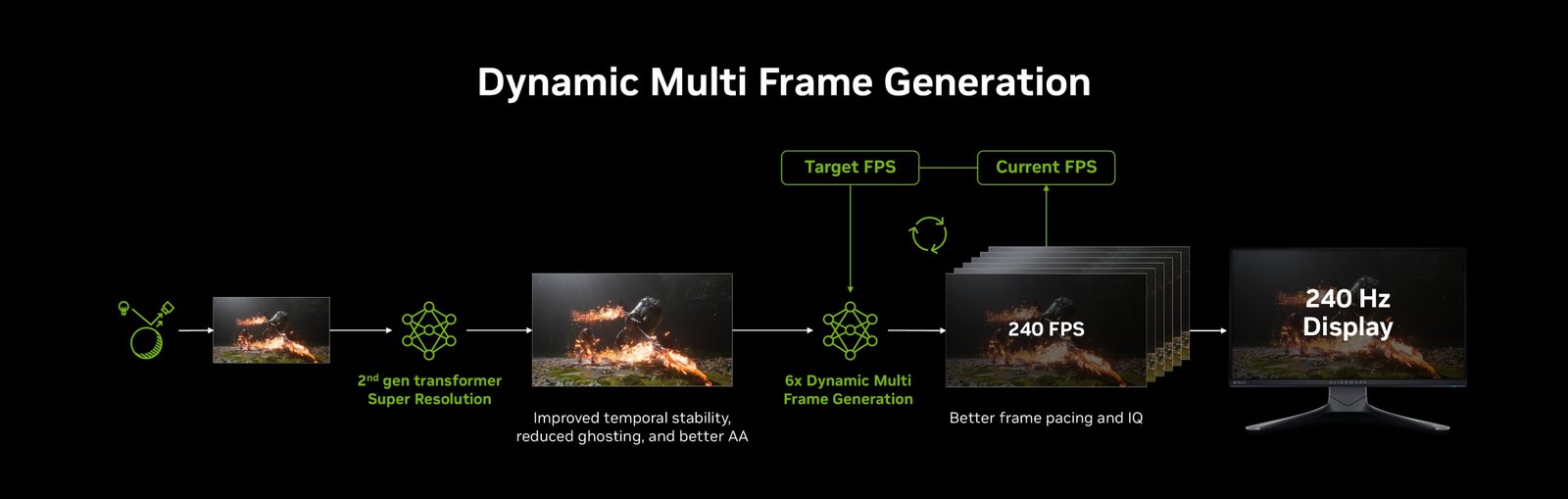

NVIDIA compares the system to an automatic transmission. When GPU performance dips during heavy scenes, frame generation increases to maintain smooth output. When the workload eases, the system scales back to reduce unnecessary processing. This allows DLSS 4.5 to target refresh rates such as 120Hz, 144Hz, 240Hz, and beyond more efficiently.
When fully enabled, DLSS 4.5 can generate up to five AI frames for every traditionally rendered frame, enabling smooth 240+ FPS gameplay at 4K with path tracing on supported hardware.
Performance gains on RTX 50 series GPUs
On upcoming GeForce RTX 50 Series GPUs, NVIDIA reports that the move from 4X to 6X Multi Frame Generation can boost 4K path-traced frame rates by up to 35%. These gains are made possible by faster Tensor Cores and improved FP8 precision, which doubles inference throughput for the new transformer model.
Despite the higher frame generation rates, NVIDIA says latency remains low thanks to continued integration with NVIDIA Reflex, ensuring responsiveness is preserved alongside higher frame rates.
Cleaner in-game user interfaces
DLSS 4.5 also improves the visual clarity of in-game user interfaces. By incorporating additional game engine data, the updated Frame Generation model produces sharper minimaps and cleaner HUD elements. NVIDIA highlighted titles such as The Outer Worlds 2, Marvel’s Spider-Man 2, Dragon Age: The Veilguard, and Starfield as examples where players will see noticeable UI improvements.
Availability and upgrade path
DLSS 4.5 Super Resolution is available now for all GeForce RTX users through a new NVIDIA app beta update. Users can enable it by selecting the “DLSS Override feature – Model Presets” and choosing “Latest,” either globally or per game. NVIDIA has confirmed that a full public release of the app update will arrive on January 13.
Dynamic Multi Frame Generation and the new 6X Multi Frame Generation mode will launch this Spring, exclusive to GeForce RTX 50 Series GPUs, with support planned for 250+ games and applications.
DLSS 4.5 reference: