

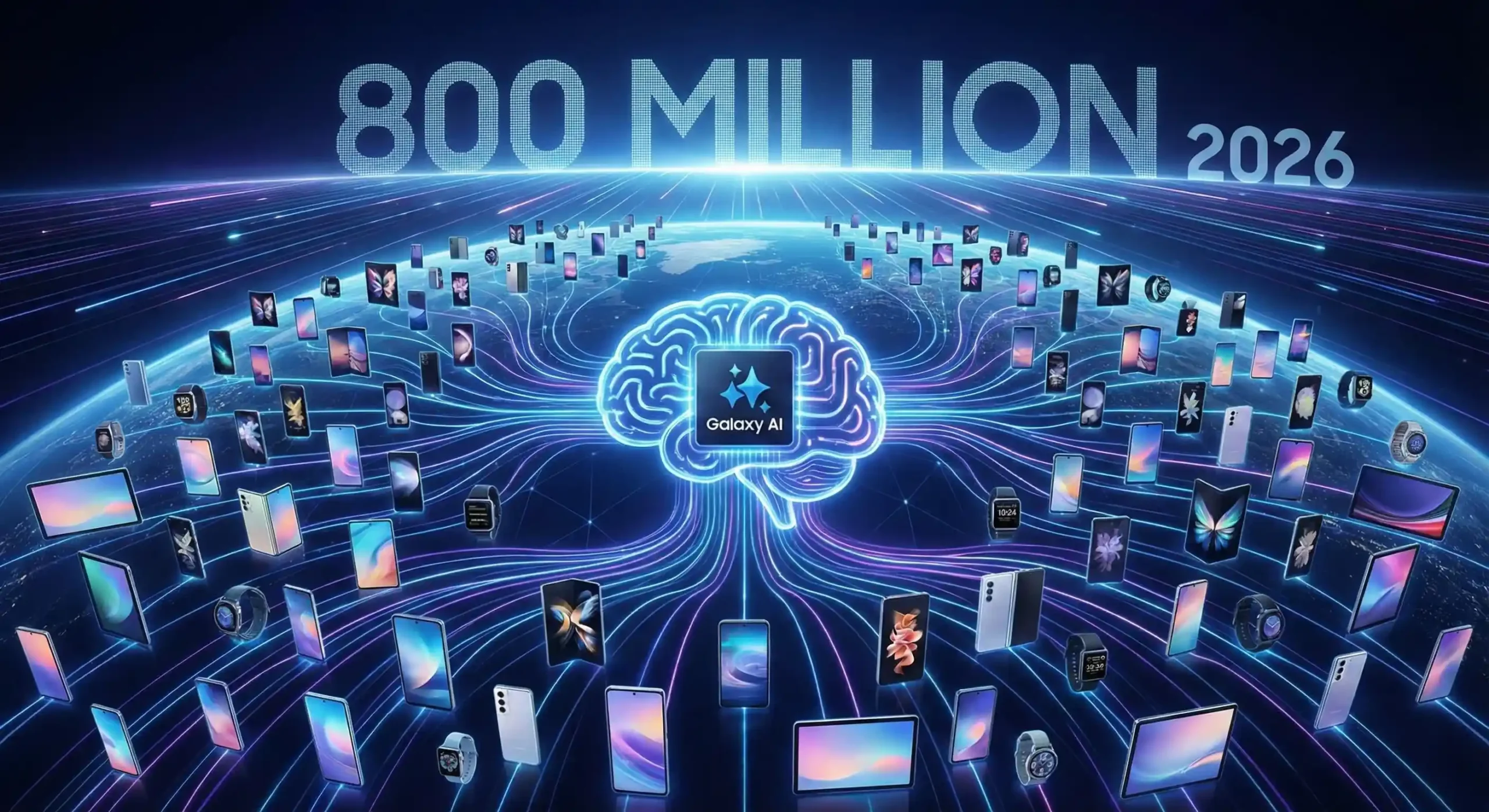
Samsung plans to significantly expand the adoption of its artificial intelligence features across mobile devices, with the goal to double the number of Galaxy AI-enabled products to 800 million units by 2026, according to Reuters.
The South Korean technology giant had already implemented Galaxy AI features on around 400 million devices, including smartphones and tablets, by last year. Google’s Gemini AI models power most of these capabilities, showcasing Samsung’s collaboration with its longtime software partner.
“We will apply AI to all products, all functions, and all services as quickly as possible,” said T.M. Roh, Samsung Electronics’ co-CEO, in his first interview since taking on the role in November.
AI at the center of Samsung’s ecosystem strategy
Galaxy AI is Samsung’s collective name for a growing set of AI-driven tools, ranging from real-time translation and text summarization to photo editing and productivity features. While many of these tools rely on Gemini, Samsung also uses its in-house Bixby assistant for specific tasks.
As the world’s largest manufacturer of Android smartphones, Samsung’s aggressive AI rollout is expected to significantly benefit Google, which is locked in intense competition with rivals such as OpenAI to bring AI tools to everyday consumers.
Google recently unveiled Gemini 3, highlighting its strong performance across several industry benchmarks. Around the same time, OpenAI accelerated its own development efforts, launching its GPT-5.2 model shortly afterward.

Competing with Apple and Chinese manufacturers
Samsung sees AI as a key differentiator as it works to regain ground in the global smartphone market, where it faces mounting pressure from Apple and fast-rising Chinese brands.
While Apple was expected to top global smartphone shipments last year, Samsung believes integrated AI services across phones, TVs, and home appliances can help it stand apart. Market research firm Counterpoint has noted that AI features are becoming an increasingly important factor in consumer purchasing decisions.
Consumer awareness of Galaxy AI surges
According to Roh, Samsung’s internal surveys show awareness of the Galaxy AI brand has climbed rapidly, jumping to around 80% from roughly 30% within a year.
Search remains the most widely used AI function on smartphones, he said, but users are increasingly turning to generative AI tools for image editing, document summaries, translations, and other everyday tasks.
“Even though AI technology may feel uncertain to some people right now, within six months to a year it will become much more common,” Roh added.
Financial backdrop: chip shortages and pricing pressure
Samsung shares closed 7.5% higher on Monday, ahead of the company’s expected announcement of a strong fourth-quarter profit increase later this week. A global memory chip shortage has largely driven the gains, boosting Samsung’s semiconductor business.
However, rising memory prices are squeezing margins in smartphones, Samsung’s second-largest revenue stream. Roh said the impact is affecting multiple product categories, including TVs and home appliances.
While he did not rule out price increases, Roh said Samsung is working with partners on longer-term solutions to limit the effect on consumers.
Smartphone market outlook and foldable phones
Market researchers such as IDC and Counterpoint expect the global smartphone market to contract next year, as higher component costs threaten to push device prices upward.
Roh also acknowledged that growth in the foldable phone segment, first introduced by Samsung in 2019, has been slower than anticipated. He attributed this to engineering challenges and a shortage of apps designed specifically for foldable screens.
Despite this, he expects foldables to become mainstream within the next two to three years. Samsung currently controls nearly two-thirds of the global foldable smartphone market, but companies such as Huawei are intensifying competition, and Apple is most likely to launch its first foldable device this year.